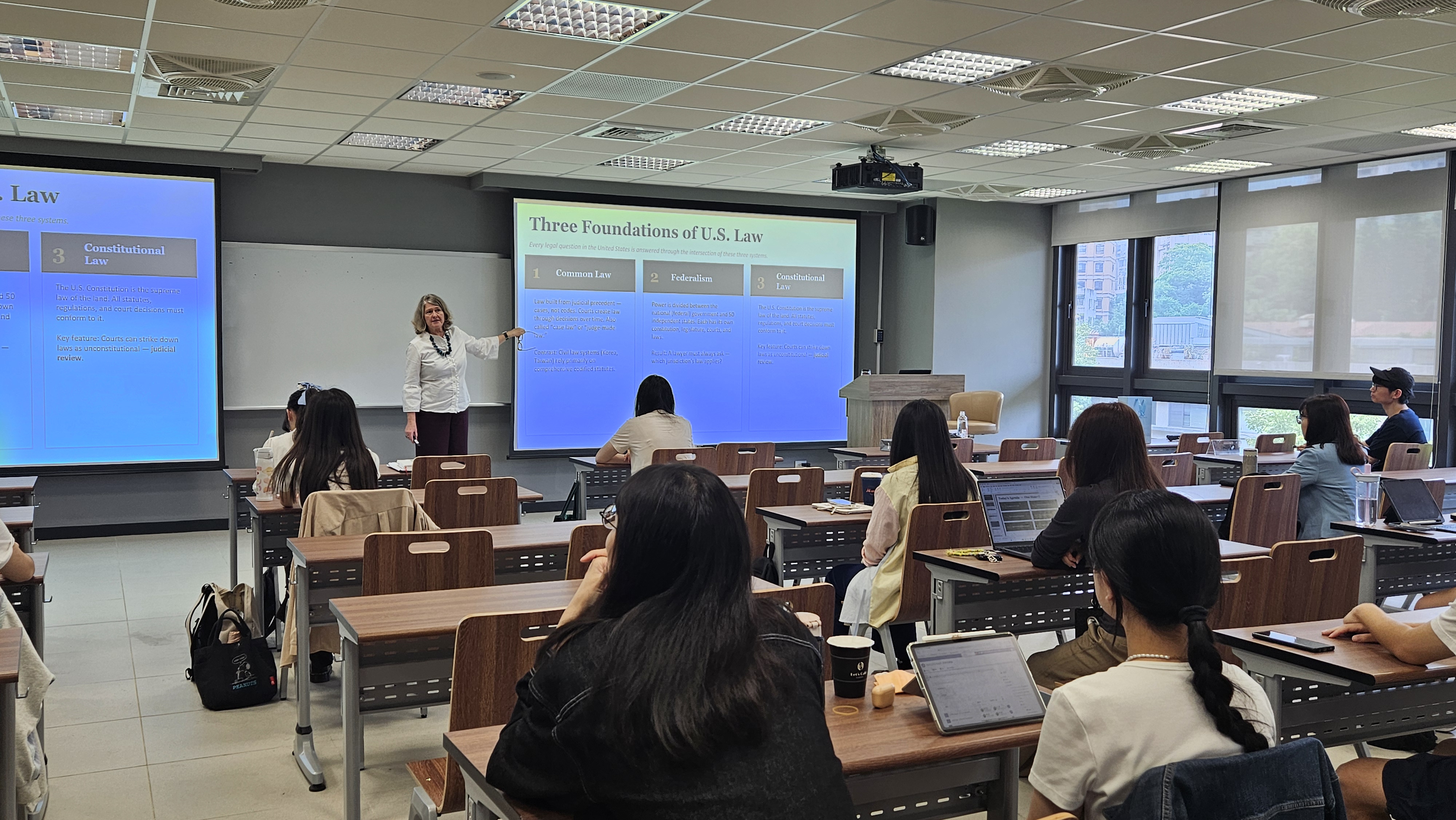
The College recently welcomed Professor Gabrielle Goodwin of Indiana University Maurer School of Law to deliver a guest lecture on the U.S. legal system in Professor Bruce Yuan-Hao Liao’s course, Introduction to Anglo-American Law. The lecture provided students with a comprehensive overview of the structure, principles, and operation of the American legal system.
The lecture began with foundational legal concepts and introduced three core pillars of the U.S. legal system: common law, federalism, and the Constitution. Professor Goodwin compared civil law and common law traditions, explaining that while civil law systems rely primarily on codified statutes, the common law system places significant emphasis on judicial precedents. Legal rules are developed through court decisions over time, reflecting the characteristics of case law and judge-made law, as well as the importance of the doctrine of stare decisis.
Institutionally, the United States adopts a federal system in which federal and state laws coexist and operate in parallel. Professor Goodwin explained that the states predate the U.S. Constitution, which was established collectively by them. The Constitution itself is relatively concise and focuses primarily on the structure of government, while many protections of individual rights are found in its 27 amendments, particularly the Bill of Rights. Both federal and state governments follow a separation of powers framework and maintain independent court systems. Whether a case is heard in state or federal court depends on the applicable law and the nature of the legal claim. Regarding constitutional review, Professor Goodwin noted that the U.S. Supreme Court holds ultimate authority in interpreting the Constitution at the federal level, while each state has its own supreme court to adjudicate issues of state law.
The lecture further explored key principles of American law, including equality before the law, due process, and the presumption of innocence. Professor Goodwin explained that the U.S. adopts an adversarial system, in which litigation is driven primarily by the parties, while judges act as neutral arbiters responsible for overseeing procedures and applying the law. A particularly important stage in litigation is pretrial discovery, during which both parties exchange evidence to ensure fairness and prevent surprise at trial. In jury trials, jurors serve as fact-finders, while judges are responsible for determining and applying the law.
The lecture also compared civil and criminal procedures. Civil cases generally involve disputes over monetary damages or injunctive relief and apply the preponderance of the evidence standard. In contrast, criminal cases involve potential deprivation of liberty or the imposition of penalties and therefore require proof “beyond a reasonable doubt.” The Constitution guarantees the right to a jury trial—this right is nearly absolute in criminal cases, while in civil cases it may be waived under certain circumstances, particularly in complex or highly specialized disputes.
In terms of legal education, Professor Goodwin introduced the structure of U.S. law schools. Students entering a three-year J.D. program often come from diverse academic backgrounds, which enriches classroom discussion and interdisciplinary perspectives. Teaching methods commonly include the Socratic method, which emphasizes active participation and critical thinking. She also presented the IRAC analytical framework (Issue, Rule, Application, Conclusion) and guided students on how to read appellate court decisions by identifying elements such as procedural history, facts, issues, holdings, reasoning, and disposition. Compared to trial court rulings, appellate opinions typically provide more detailed legal analysis and reasoning.
Finally, the lecture addressed legal career pathways in the United States. Graduates seeking to practice law must pass a state bar examination, and in recent years, many jurisdictions have adopted the Uniform Bar Examination (UBE), facilitating cross-state mobility. Some students may also pursue advanced degrees such as an LL.M. or S.J.D. to further specialize in specific fields of law such as tax and cybersecurity.
The lecture concluded with an engaging Q&A session, during which students raised questions on topics such as multi-party litigation and complex procedural issues. The session not only deepened students’ understanding of the U.S. legal system but also broadened their global legal perspectives and encouraged international academic exchange.