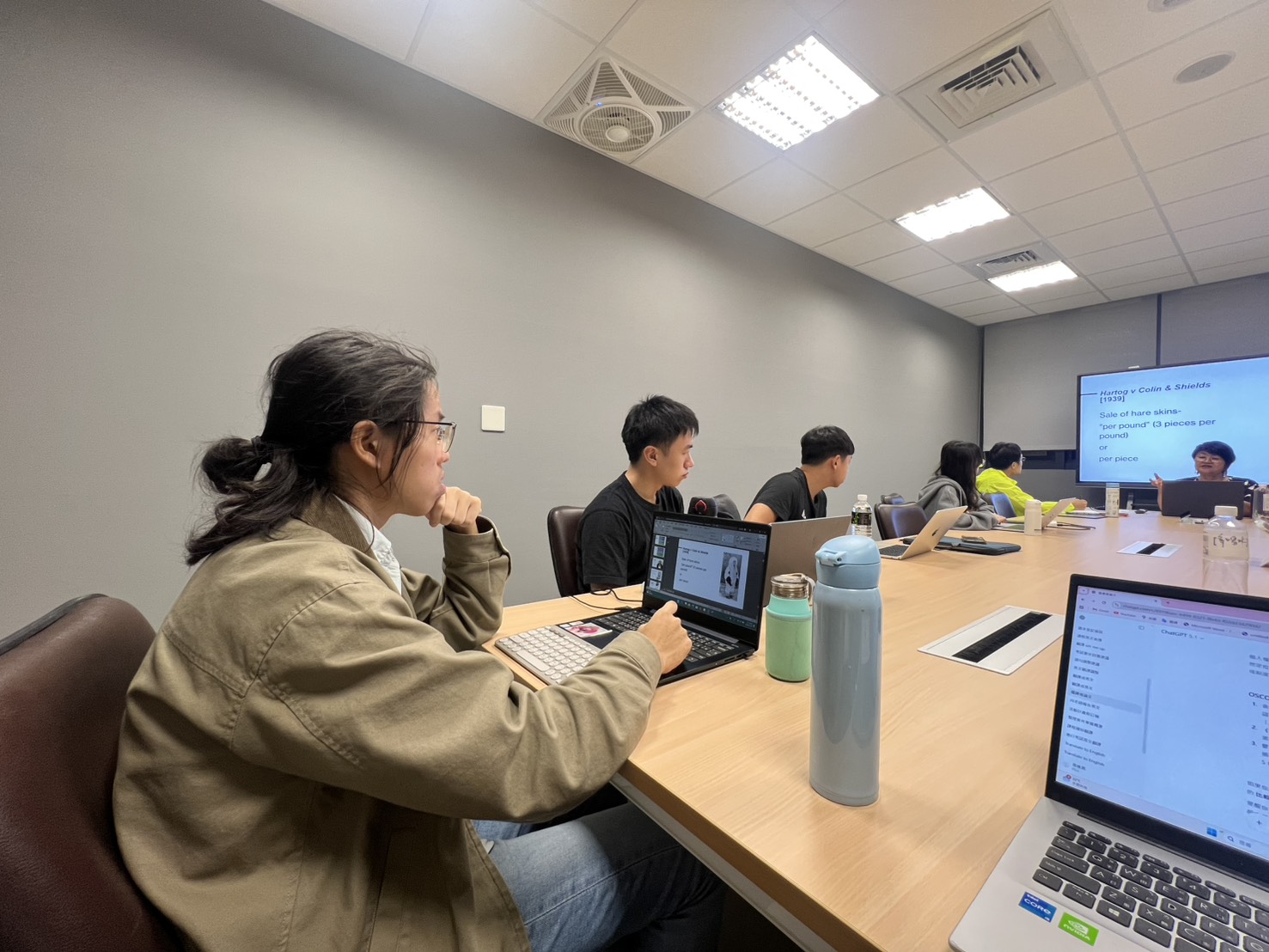
Professor Chen-Wishart emphasized that the operation of law is never confined to statutory provisions, judicial decisions, or abstract rules found in textbooks. Rather, it is profoundly shaped by a country’s social environment, societal values, historical background, and cultural traditions. Instead of relying solely on “cold and mechanical” reasoning based on statutes and precedents, legal application should return to the historical context and human realities in which disputes arise, assessing whether legal norms remain appropriate within specific circumstances.
One of the most memorable aspects of the course for students was Professor Chen-Wishart’s discussion of cases in which courts in the United Kingdom and Singapore reached entirely different conclusions despite applying the same UK precedents and legal principles. She explained that such divergences often stem from differences in cultural foundations. For example, Singapore’s legal reasoning is influenced by Confucian values, which emphasize social order, collective interests, and responsibility. As a result, judges’ value judgments and modes of reasoning in contract law may differ significantly from those of UK courts. These comparisons enabled students to appreciate the deeper social, historical, cultural, and value-based dimensions underlying comparative law, highlighting the inseparable link between legal operation and cultural context.
In addition, Professor Chen-Wishart is well known for her highly interactive teaching style. Each class encouraged students to raise questions and share perspectives, engaging in critical debate over judicial reasoning and the spirit of legal norms. Students actively participated in discussions and frequently offered observations drawn from Taiwan’s legal system, generating dynamic exchanges and fresh insights throughout the course. Through this intensive and rigorous training, students not only deepened their understanding of UK contract law but also made significant progress in critical legal thinking, cross-jurisdictional analysis, and legal communication in English.
Following the successful completion of the course, the College of Law at NCCU reaffirmed its commitment to advancing international legal education. The College plans to continue inviting leading scholars from abroad to teach in Taiwan, further expanding students’ global perspectives and strengthening the capacity of Taiwanese legal professionals to engage with the international legal community.