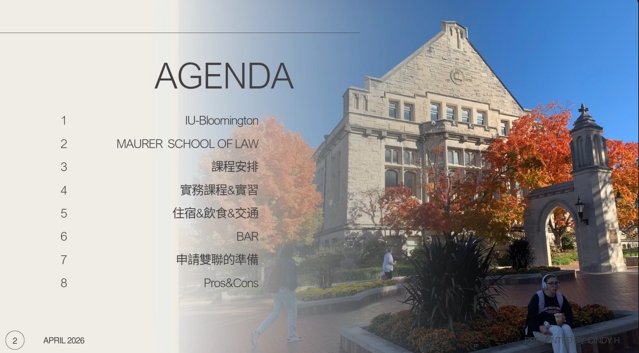
The College of Law hosted an LL.M. dual degree experience sharing in the Indiana University Maurer School of Law on the evening of April 30. The event was moderated by Ms. Yvonne Chen, who invited Hsin-Yun Hsieh to share her academic experiences.
The session began with an introduction to the College’s dual degree programs by Ms. Yvonne. She noted that application timelines, program brochures, and partner university lists are all available on the College of Law website, and encouraged interested students to regularly check for updates. She also explained that there are two primary pathways for students pursuing a Master of Laws (LL.M.) degree abroad: dual degree agreements and scholarship partnership agreements. Students applying through the latter must independently apply for study abroad in the iNCCU system.
Hsieh then shared her experience studying at Maurer School of Law, which is part of Indiana University Bloomington, the flagship and largest campus of the Indiana University system, located in the state of Indiana. The campus features a classic American college atmosphere, with the football season being one of the most significant annual events. In addition, a wide range of campus activities allows students to build a rich and fulfilling university life without leaving campus.
Academically, Maurer School of Law is smaller in scale compared to University of Southern California and Georgetown University, offering a more intimate, small-class learning environment. This allows faculty and administrative staff to better understand and support individual students. Hsieh encouraged students to take full advantage of these close connections, whether for academic support, career advice, or exam preparation, noting that professors are generally very willing to help.
She also pointed out that the majority of students at Maurer are enrolled in the Juris Doctor (J.D.) program, making the coursework intensive, rigorous, and competitive. While this may be challenging at first, it also serves as a strong driver for rapid academic growth. The LL.M. program requires the completion of 24 credits, and course selection must be discussed with an Academic Advisor to align with students’ career plans. Therefore, those intending to take a U.S. bar examination are advised to plan early and consult with their advisors.
Hsieh further emphasized that the eligibility review process for U.S. bar exams is time-consuming. Considering document processing and mailing times, students are advised to submit their applications at least one year in advance—before departing for the United States—to avoid disruptions to their exam schedule.
Regarding daily life, she noted that due to its geographic location, the cost of living—particularly housing and food—is significantly lower than in major cities. Public transportation is generally sufficient for daily needs, and with careful planning, students can effectively manage and reduce their expenses.
During the Q&A session, students asked whether internships or work experience are important for LL.M. applications, and whether academic performance, English proficiency, and recommendation letters are advantageous. Hsieh explained that since many LL.M. students already have professional experience, having relevant background can help highlight one’s strengths. However, she stressed that strong English proficiency remains the most critical factor, as it ensures that students can successfully handle the academic workload.